Silo as a Distributed System: Finite Redundancy, No Clear Exit
A software engineer's reading of Silo as a finite distributed system that can consume its redundancy but cannot replace it.
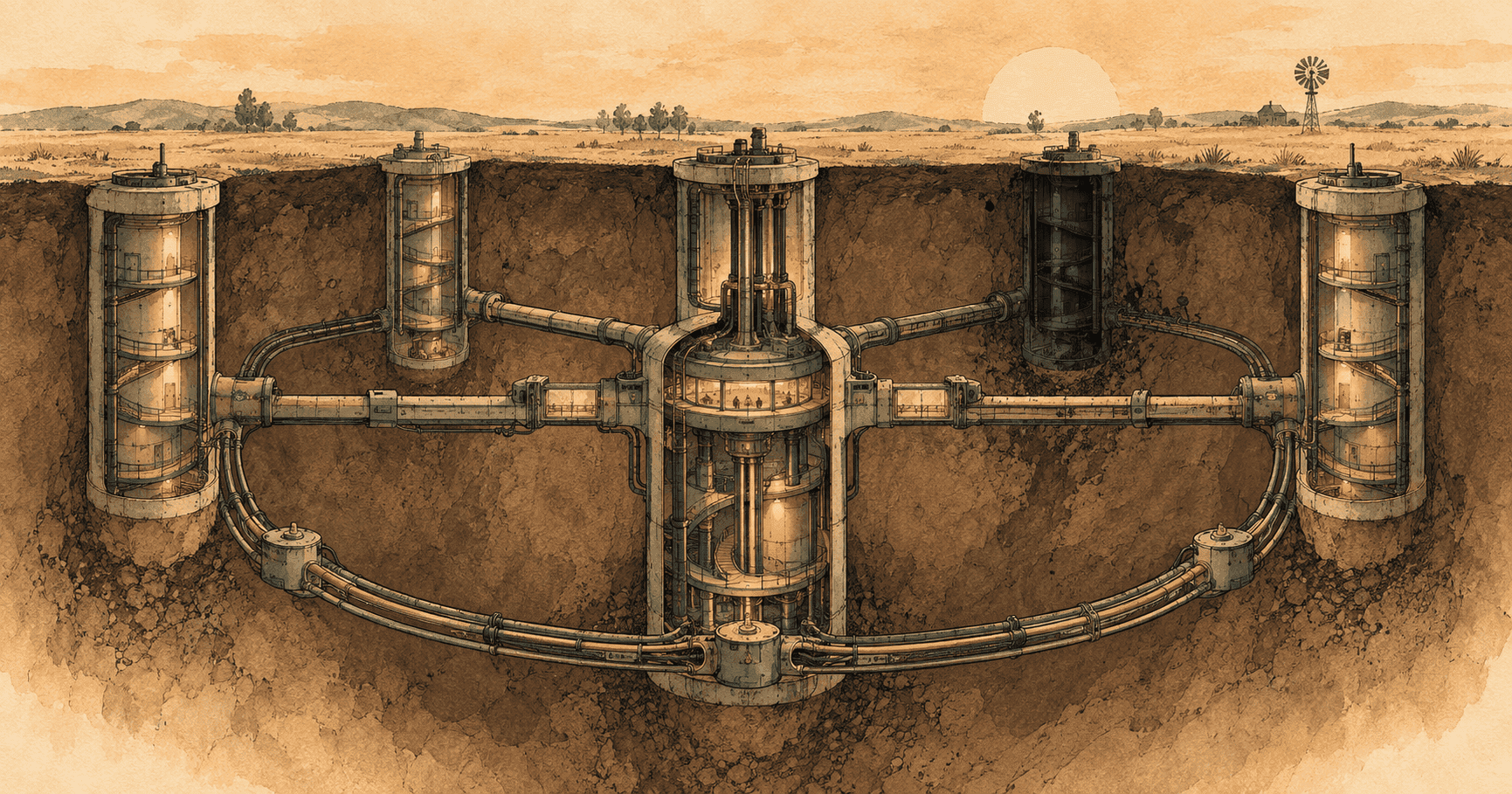
Spoiler warning: This article contains minor spoilers from seasons 2 and 3.
While watching Silo, I started seeing its world as a systems-design problem rather than only a political or post-apocalyptic story.
The founders have a catastrophic problem to solve. They respond by placing humanity in multiple isolated silos. Each silo has a fixed population, its own infrastructure, strict operating rules, central monitoring, and a procedure for dealing with a silo that becomes dangerous.
In software terms, it resembles a distributed system made of isolated nodes.
I am assuming that the intended requirement is to preserve humanity until people can safely return to the surface. Under that assumption, the design looks resilient at first. There are many copies of humanity, and a failure in one silo does not immediately destroy the others.
But the architecture appears to contain two related risks:
- Its redundancy can be consumed but not replaced.
- It has no visible exit condition.
The second risk makes the first one increasingly dangerous.
The system cannot scale out
The founders built a fixed number of silos with finite physical resources:
TOTAL_SILOS = fixed
POPULATION_PER_SILO = limited
PHYSICAL_RESOURCES = finite
REPLACEMENT_CAPACITY = finite
A modern service can sometimes respond to capacity pressure by adding another node. The silo system cannot.
scale_silos(50 -> 75) // impossible
There is no visible supply chain, workforce, or surface infrastructure for building replacements. Every lost silo appears to permanently reduce the capacity and diversity of the whole system.
That matters because its failure handling appears to be destructive:
if silo_becomes_uncontrollable:
    terminate(silo)
Losing one silo may look acceptable when many remain. That reasoning assumes failures will stay both rare and independent. Over centuries, neither assumption is safe.
All silos may share generator designs, agricultural systems, software, procedures, and political structures. A defect in one shared design can create correlated failures across many nodes. Age also affects them together. Their machines, knowledge, and institutions are all exposed to time.
The system has redundancy, but it has no obvious way to renew that redundancy.
A reserve that cannot replenish
Imagine operating fifty servers and permanently destroying any server that behaves unexpectedly.
servers = 50
failure -> servers = 49
failure -> servers = 48
...
failure -> servers = 0
This can absorb failures for a while, but it is consuming a reserve rather than renewing one.
The silo count is a non-renewable redundancy reserve. More importantly, that reserve contains people. Deleting a node also deletes part of humanity's remaining genetic, cultural, intellectual, and demographic diversity.
A healthier system would have other recovery paths. It might repair a damaged node, evacuate its state, or let it run with reduced functionality. These are different strategies, but all preserve more of the system than deletion does.
The apparent response in Silo is fault containment through node deletion:
Silo becomes unstable
        ↓
Silo is terminated
That protects the remaining network from an immediate threat, but permanently weakens the network it is meant to protect.
A 500-year system still needs an exit condition
The larger problem is not that failures can happen. Every system fails.
The runtime is not unknown. The founders' plan is roughly 500 years.
That is finite, but it is still an extreme assumption for a closed system expected to preserve machinery, knowledge, institutions, and human populations. A target duration is also not the same as an operational definition of success. The people maintaining the system still need to know what should trigger the transition out of it.
A temporary survival system should have a loop like this:
while outside_is_not_safe:
    protect_population()
    maintain_infrastructure()
    monitor_environment()
    evaluate_conditions()

begin_resettlement()
The loop ends when the original danger has passed.
What we see from inside the silos looks closer to this:
for year in planned_500_year_runtime:
    maintain_isolation()
    enforce_the_directive()

    if silo_breaks_rules:
        eliminate_silo()

    if population_attempts_escape:
        contain_population()
The missing line is:
if resettlement_criteria_are_met:
    begin_migration()
Without an accessible and testable condition, the system has a duration but no clear migration mechanism.
Suppose a silo has a small probability p of catastrophic failure during a given period. Under a simplified independent-failure model, its probability of surviving 500 periods is:
(1 - p) ^ 500
Even when p is small, exposure across 500 periods compounds the risk. Real silos would be more complicated, and their failures would not always be independent. Shared designs and shared ageing could make the risk worse.
The point is not that failure is certain. It is that five centuries is long enough for low-probability events to accumulate. A system designed for that lifespan needs repair, replacement, adaptation, and a planned transition.
This connects the two risks. A five-century runtime gives the system many opportunities to consume its finite redundancy.
Contradictory evidence should become telemetry
Long-running control systems need feedback. They observe reality, compare it with their model, and update their behaviour.
The silo system appears to follow the lower branch. The founders' assumptions become rules. The rules become the Directive. Later generations enforce the Directive without necessarily understanding why it exists.
When evidence conflicts with the inherited model, the system treats the evidence as dangerous.
Silo 17 should be valuable telemetry. A failed silo can reveal weaknesses in governance, containment, maintenance, and recovery. If the control system observes a person surviving outside longer than expected, that should trigger investigation.
That observation does not prove the surface is safe. It does show that reality can produce a state the operating model did not expect.
A healthy response would look like this:
Unexpected outcome observed
        ↓
Verify the observation
        ↓
Re-evaluate environmental assumptions
        ↓
Update policy if needed
Instead, the system appears to restore the expected state by removing the exception. That is like fixing a failing test by deleting the test.
The system does not only fail to learn. It removes information that could show where its model is wrong.
The process becomes the requirement
The original objective may have been:
Preserve humanity
Over generations, the operational objective becomes:
Preserve the silo system
Those goals are not identical.
This happens in smaller forms in software teams and organisations. A process is introduced to achieve an objective. As its original context fades, compliance with the process becomes the objective.
People stop asking:
Is this rule still helping us?
They ask:
Are people following the rule?
In Silo, the dependency appears to reverse. The silos were built to protect humans, but humans are forced to behave in ways that protect the silos. The same problem can be understood as specification drift.
The original requirement may have been:
Keep populations isolated until humanity can safely return.
Future operators inherit implementation details:
Prevent communication
Restrict historical knowledge
Suppress rebellion
Prevent escape
Terminate dangerous silos
After enough generations, the implementation becomes indistinguishable from the requirement. People know what the Directive says, but not what evidence produced it or when it should stop applying.
It resembles ancient production code surrounded by a warning:
// DO NOT REMOVE.
// The system breaks if this changes.
Now imagine that comment controlling civilisation centuries after the engineer who wrote it has died.
The world can change while the policy remains on version 1. There is no visible mechanism to update the Directive, change governance, test a new policy safely, or roll back a bad decision.
The founders appear to have shipped civilisation with immutable configuration.
Physical distribution can hide central control
The silos are physically distributed, but their governance may be logically centralised around Silo 1.
If one authority controls monitoring and destructive mechanisms for the others, that authority is a control-plane dependency. Its failure could leave the remaining silos unable to discover the truth, coordinate safely, disable those mechanisms, or begin resettlement.
Under those conditions, the distributed appearance hides a single point of failure.
A temporary system needs migration and liveness
If the silos are a temporary response, they need a transition back to ordinary human life.
That lifecycle might include:
- Move people underground when catastrophe is detected.
- Maintain the population while monitoring the surface.
- Run controlled expeditions and verify changing conditions.
- Restore knowledge and reconnect silos gradually.
- Resettle the surface and decommission the underground system.
Instead, the visible plan seems to contain only two phases:
Phase 1: Enter the silo
Phase 2: Stay in the silo
That is containment, not recovery.
Distributed-systems engineers distinguish between safety and liveness.
Safety means something bad never happens:
Rebellion does not spread
Silos do not communicate freely
Forbidden knowledge does not circulate
People do not leave without permission
The founders appear heavily focused on these properties.
Liveness means something good eventually happens. For this system, the essential liveness property should be:
Humanity eventually leaves the silos
A system can preserve safety while making no progress. Humanity may survive another day, year, or century, but if it can never rebuild outside, the system has frozen the original problem rather than solved it.
The founders designed extensively against futures they feared. They seem to have spent less effort defining the future they wanted the system to reach.
What if preservation was never the real requirement?
There is another possibility: perhaps these are not bugs.
Everything above assumes the real specification was:
Preserve humanity until it can safely live outside again.
But what if the actual requirement was closer to:
Produce a controlled form of humanity that satisfies particular social, genetic, or political criteria.
Under that requirement, isolation, historical erasure, suppression, and central selection may be features.
This leaves the most important question unresolved: what was the founders' actual objective?
Software can behave exactly as specified and still create a terrible outcome. Engineers often focus on whether an implementation matches its requirements. Silo asks what happens when the requirement itself is the problem.
The old specification may still be running
The founders solved an immediate survival problem, created redundancy, built monitoring, and kept a complex physical system operating across generations.
But they appear to have designed for the conditions that existed at the beginning, without giving future generations a safe way to respond when those conditions changed.
A finite-resource system cannot safely assume five centuries of operation without adaptation. Persistent failure risk and no renewal can consume fixed redundancy over that period. Contradictory evidence cannot improve the model if the system destroys it. Safety rules cannot complete a mission that has no accessible liveness condition.
That is what makes Silo interesting to me as an engineer. It resembles a legacy production system running a centuries-old specification with finite infrastructure, destructive failure handling, immutable configuration, a central control plane, and no clean shutdown procedure.
It may still be behaving according to its actual design. The unresolved question is whether preserving humanity was ever the whole requirement.