When to Use Claude Skills and Agentic Loops
A practical way to decide when a Claude Skill should provide a workflow, domain context, or a bounded agentic loop.
Coding with AI used to mean writing a prompt in ChatGPT, copying the answer, and pasting the code into an editor.
Now I work with tools such as Claude Code, Cursor, and Conductor. They can read a codebase, generate changes, run commands, and review the result. This has made development faster, but it has also exposed a repetitive problem.
I often ask an agent to complete the same type of task with almost the same expectations. Because AI models are non-deterministic, the process and outcome can vary each time. One run remembers to update the tests. Another misses the related documentation. A third interprets the same short prompt differently.
A SKILL.md file gives me a way to document how I want a task handled. It does not make the model deterministic. It gives the model a clearer workflow, better context, and a more consistent definition of done.
What makes a useful skill
A good skill is personal. It captures the checks, decisions, and working style that matter to the person or team using it.
My skills usually fall into three groups.
1. Development workflow skills
The first group covers repeatable development tasks.
Examples include a bug review, a refactor, or a research task. Instead of explaining the process every time, I invoke a skill that already tells the agent how I expect that task to be done.
The skill acts like a built-in prompt for a specific job. It can describe what to inspect, which checks to run, what should not be changed, and what the final response should contain.
This is useful when I already have a process I like and want the agent to follow it without rewriting the same prompt for every session.
2. Context skills
The second group combines feature context with a workflow.
Suppose I am working on a car dealership platform with an insurance feature. That feature may have checks I need almost every time it changes. A new API might need to be verified against the insurance provider. Publishing that API might also require a specific document to be updated.
Some of this could live in CLAUDE.md, but putting every feature-specific workflow there would make the main project instructions large and difficult to maintain.
A context skill can hold the information and checks for that feature together. When the agent works on insurance, it loads the relevant context and follows the related workflow. Other tasks do not need to carry those instructions.
I find this especially useful for large codebases and monorepos, where each domain has its own dependencies and definition of done.
3. Agentic loop skills
The third group is the one I use most now.
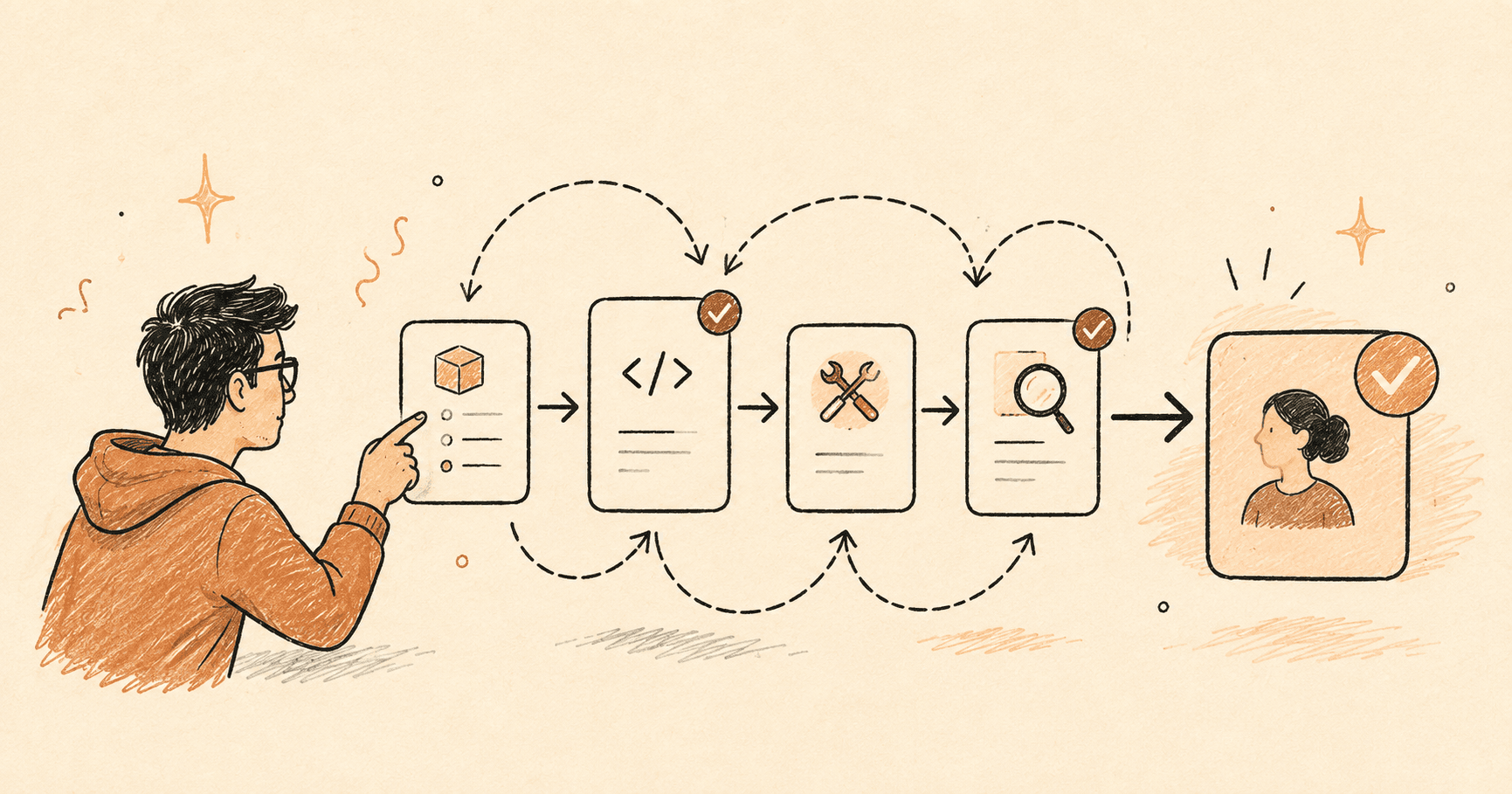
These skills combine smaller skills, scripts, and checks into a complete workflow. I think of them as agentic loops because the agent does not stop after the first problem. It uses the result of each check to decide what to do next, then keeps working until it reaches the goal or a decision needs human input.
One workflow I use is called ship-it. It takes code I have added and moves it through the rest of my delivery process:
- review the changes for bugs
- check linting and formatting
- review test coverage
- look for side effects that require related updates
- fix issues found by those checks
- commit the completed changes
- create a pull request and return the link
I used to guide the agent through these steps one prompt at a time. With the workflow captured as a skill, I can start the whole process with one line.
The important part is not the number of steps. It is the feedback loop. If linting finds an issue, the agent fixes it and runs the relevant check again. It does not hand the failure back to me when the next action is already clear.
This is where agentic loops are most useful: the goal is clear, the checks produce useful feedback, and the agent can safely correct problems without asking a person to approve every small step.
Where skills go wrong
Not every set of instructions should become a skill.
The skill contains too many ideas
A verbose skill with several unrelated goals is hard for both the model and the developer to follow. It also becomes difficult to know which part caused an unexpected result.
I prefer a focused skill with one clear purpose.
The skill creates documentation debt
A skill that keeps appending to shared documentation can make those files massive. The immediate automation feels useful, but the result becomes difficult to read and maintain.
The skill should update documentation only when the workflow genuinely requires it, and it should be clear about which document owns that information.
The instructions are vague
“Review this thoroughly” is not a workflow. A useful skill needs a clear goal, concrete checks, and a definition of done.
The model still needs room to reason, but it should not have to guess what success means.
The loop has no practical boundary
An agentic loop can spend hours changing code, rerunning checks, and consuming tokens without getting closer to the goal.
Balance matters. A loop should continue when feedback is actionable. It should stop when the same failure repeats, the next step is unclear, or progress depends on a decision only a person can make.
The loop makes expensive decisions alone
Some decisions are cheap to reverse. Fixing a formatting error is one of them.
Other decisions can lock the implementation into an approach that is expensive to undo. If a loop makes those choices without a checkpoint, the final result can create more bugs and more development work than it saves.
The more costly a decision is to reverse, the more reason there is to keep a person in the loop.
The skill cannot be reused
A skill should solve a repeated problem. If its instructions only make sense for one exact task, writing and maintaining the skill may cost more than giving the agent a direct prompt.
When I would create a skill
I would create one when I notice that I am repeating a prompt, correcting the same omission, or guiding an agent through the same sequence of checks.
I would use a development workflow skill for a repeatable task, a context skill for a domain with its own rules, and an agentic loop when the goal is clear enough for the agent to keep acting on feedback safely.
The value is not in having a large collection of skills. It is in capturing the workflows that already work for me and removing repeated supervision without removing the important human decisions.
I think bounded agentic loops are the most useful direction for skills. They let us turn a one-off prompt into a repeatable process, while still making it clear when the agent should continue and when it should stop.